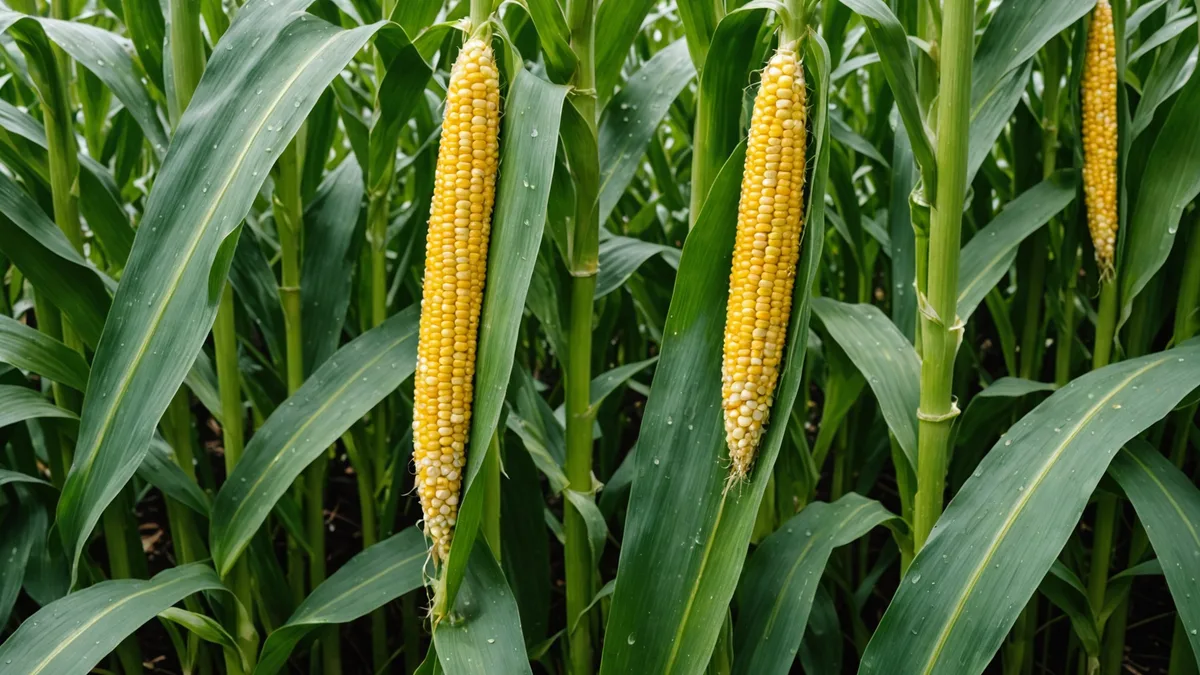
Why timing usually beats rate in the field
From R1 (silking) through R4 (dough), the upper three to four leaves carry most of the photosynthesis that supports kernel development. This group includes the ear leaf, as it is sometimes called, plus the two leaves directly above it. A fungicide creates economic value chiefly by keeping that upper canopy healthy through mid-grain fill. In years with disease pressure, protecting those leaves is what produces the yield response, making canopy protection during grain fill more important than the application rate alone.
Application rate has a role, but timing carries more weight. A full-label-rate treatment at V8 cannot protect the upper canopy at R1, because the R1 canopy has not formed yet. Once the ear leaf has expanded and the tassels emerge, the lower leaves treated early may have senesced, or the active ingredient may be beyond its disease-suppression window. Provided label requirements are met and extreme dilution has not reduced efficacy, a half-label rate from VT to R1 offers more relevant protection than a full-rate treatment two to three weeks earlier.
Defining the VT-R1 application window
At VT, the tassel has fully emerged and the top leaf blade is visible. R1 is the day silks emerge. For practical fungicide timing, target VT minus two to three days through R1 plus two to three days. Most applicators aim for "as close to silk as I can get given my application schedule and weather windows."
That narrow window follows from foliar fungicide behavior. Strobilurin and triazole fungicides currently in use offer both curative and protectant activity, though their curative window is narrow. An established gray leaf spot lesion present at an R2-or-later application is not meaningfully affected. Protectant activity depends on having fungicide on the leaf before infection. With active airborne spore loads, VT brings rapid canopy expansion and exposes substantial new tissue. Applying protectant to that tissue before the first major infection events explains the emphasis on timing.
Using canopy humidity to refine timing
Corn fungicide timing guidance from extension has traditionally combined hybrid disease susceptibility, field disease history, and regional inoculum pressure. Those inputs remain valid, yet neighboring fields planted to the same hybrid can show meaningfully different canopy humidity profiles at VT. That difference directly changes the environment in which disease infection occurs.
Humidity sensors placed at ear height in a corn stand measure how long leaves remain wet where infection has the greatest consequence. A canopy with leaf wetness lasting above eight hours per day for three or more consecutive days during silking faces a materially higher infection environment than one that reliably dries overnight because of better air drainage.
In Harva's design-partner field data, we begin tracking cumulative leaf wetness at ear height at VT. If the first 10 days post-VT contain more than 40 cumulative wet hours, we flag the field for fungicide application review when no application has already been submitted. The flag does not tell you to spray. Instead, it prompts a discussion with your agronomist about whether disease history and hybrid rating justify the investment at current corn price and fungicide cost. Results vary by field, hybrid, and season, and the humidity flag does not replace your agronomist's judgment about application economics.
Where rate matters
Rate becomes important in a particular situation: disease is already established when you apply, and the active ingredient's curative activity must slow lesion expansion while new tissue is protected. If gray leaf spot or Northern corn leaf blight is visible in the mid-canopy before VT during a high-pressure season, a higher rate within label specifications gives greater suppression of existing disease spread. It will not eliminate the disease, but in a high-pressure year the difference between a labeled low rate and a labeled high rate is measurable.
The difficulty is that growers usually choose a fungicide strategy before knowing whether the season will bring high pressure. Using the high-pressure rate across every field and year raises input costs without a proportional yield response in most years. From an expected-value perspective, applying at a standard label rate within the VT-R1 window is more valuable than choosing the rate correctly but arriving two weeks late.
ROI realities in average years
Corn fungicide does not always pay. In a dry year with low leaf wetness duration and a resistant hybrid, even a perfectly timed VT treatment will produce no measurable yield response in many fields. The application still costs money, while the disease reduction needed to drive yield response is absent. Pursuing fungicide ROI under low disease pressure adds cost without a matching benefit.
Regional extension breakeven analyses have generally set the corn fungicide threshold at roughly 5 to 7 bushels per acre of yield response to cover a typical aerial or ground application, with the exact point depending on application costs and corn price. Response remains inconsistent and field-specific in average disease-pressure years. With susceptible hybrids in high-pressure years, it can reliably exceed that threshold. The range supports field-level decisions rather than a blanket practice across an operation, while reinforcing that timing and disease-pressure assessment matter more than routinely choosing the highest label rate.
Using the humidity flag in your prescription
If Harva's weekly delivery flags canopy humidity for a corn field nearing VT, do not schedule a spray immediately. First confirm the hybrid, review local disease history for gray leaf spot or tar spot pressure, and consider what the current corn price means for the breakeven yield response.
If those three considerations support treatment, control the timing first. In a field with documented disease risk and an active humidity environment, applying within three days of VT delivers the greatest value. Choosing a rate within label specifications is secondary to making the window, rather than waiting for conditions to support a less important rate threshold.
As with any in-season application, Harva's prescription flags should inform, not replace, the discussion with your agronomist. Field-specific disease history, hybrid resistance ratings, and local extension guidance provide context that imagery and sensors alone cannot fully capture through remote sensing.